
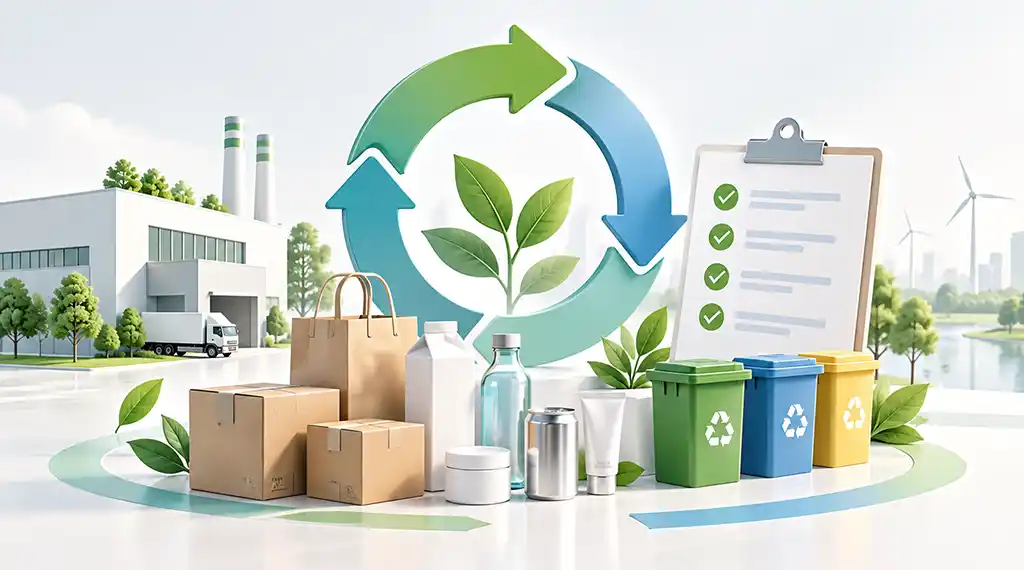
The upcoming changes in the law are a major challenge, as 2026 is the year a system shifting disposal costs onto those who place products on the market comes into force. The new rules are not just about fees for packaging recycling; they mean a complete rethink of product strategy and of how companies approach the packaging life cycle. Proper preparation will help businesses avoid organisational chaos and heavy financial penalties that could shake the liquidity of many companies.
The concept known as extended producer responsibility requires companies to factor in environmental costs as early as the design stage of a product and its packaging. Above all, the system aims to motivate producers to adopt eco-design, so that waste becomes easier to process or can be removed from circulation altogether. In practice, the harder a company's packaging is to recycle, the higher the costs it bears through the product or recycling fee. This mechanism is becoming a core part of the sustainability strategy of every modern organisation.
The mechanism is based on the “polluter pays” principle, which translates directly into an obligation to finance the collection, transport and final management of waste generated by the products a company places on the market. Extended producer responsibility is not just a theoretical provision in the law but a real financial instrument designed to make the use of low-quality plastics simply unprofitable for business.
The European Union has been pursuing ambitious climate targets for years, and the growing mountain of packaging waste has become one of its legislative priorities over the past decade. EU environmental law aims to harmonise standards, so it is worth reading about the new rules of the game in the circular economy, which set the direction of change for the entire European economy. The main goal of the directive is to achieve high recycling rates and create a secondary market for raw materials, ultimately leading to a significant reduction in the extraction of natural resources.
The list of entities required to implement the new procedures is very broad and includes practically every business that places packaged products on the Polish market, regardless of its size. It applies to large corporations as well as online shop owners and distributors, who will bear the costs directly, which will force them to review their suppliers' packaging solutions.
The most important task for businesses will be paying fees that cover the cost of waste management, with the amount depending on the type and quantity of material placed on the market. Beyond the financial side, companies will have to label products correctly, telling consumers how to sort each type of packaging, which is fundamental to the quality of the collected material. Reverse logistics is also important, which is why professional waste storage and transport is becoming an integral part of business processes in every modern company.
The system, which is due to apply in full in 2026, will cover almost every sector of the economy, with particular emphasis on FMCG, electronics and e-commerce. Implementing EPR 2026 will require producers of beverages, food and household chemicals to completely redesign their packaging so that it meets strict recyclability standards. The changes will not bypass the automotive or construction sectors either, where responsibility for renovation and operational waste will be tightened significantly compared to today.
The digitalisation of environmental processes means that every tonne of packaging placed on the market and every tonne of waste generated must be recorded in an IT system. Properly kept records in the Polish database on products, packaging and waste management (BDO) are becoming the main proof that a company has met its statutory obligations to the state. If your company needs support in this area, it is worth turning to experts such as Wastes Service, who provide comprehensive support for environmental and reporting processes.
Ignoring the new rules can prove extremely costly, as the law provides for a range of severe administrative sanctions for failing to register or for keeping unreliable records. Fines can reach up to one million zlotys, and in extreme cases business activity may be suspended or specific products withdrawn from the market until the arrears are settled.
To avoid unpleasant surprises and prepare for the upcoming changes as well as possible, companies should carry out a detailed analysis of the processes involved in placing products on the market. A professional EPR audit makes it possible to identify precisely which packaging generates the highest costs and where there is potential to optimise it by switching to more environmentally friendly materials. Comprehensive environmental education and audits are the best investment a company can make before the strictest rules come into force in 2026.
A single business rarely has the resources and infrastructure needed to collect and process on its own the tonnes of waste scattered across the market. That is why producer responsibility organisations play such an important role: on behalf of the companies placing products on the market, they take over the obligation to meet recycling targets, organising collection systems and working with recyclers.
Implementing extended producer responsibility is a fundamental step towards transforming the whole economy into a circular model in which waste becomes a valuable resource. The circular economy offers companies not only regulatory compliance but also greater raw material security, thanks to the recovery of materials that can go back into production. It is worth looking at the challenges and opportunities of the circular economy from a local perspective, because it is at the level of local governments and local businesses that closing the loop delivers the most tangible results.
The benefits of adopting a circular model fall into several main areas:
Navigating constantly changing regulations requires specialist knowledge and experience that manufacturing and trading companies often lack in-house. The Wastes Service team of experts offers comprehensive support, from analysing the current state of waste management to implementing the procedures needed to meet EPR 2026 requirements. The coming revolution in environmental law does not have to be a threat to your company if you take preparatory steps early and introduce the necessary changes.
As an industry leader, Wastes Service Group goes beyond standard consulting by investing in real processing infrastructure, as shown by the opening in Wszemirów of the most modern plant of its kind in the CEE region, the Battery & E-Scrap Recycling Park. Advanced Industry 4.0 technologies and a unique line for dismantling electric vehicle chassis allow the company to actively strengthen the European Union's raw material sovereignty by closing the loop on critical raw materials. More than 25 years of experience guarantee that businesses are entrusting their obligations to a partner fully prepared for the challenges ahead.