
Understanding the specific nature of secondary raw materials is the basis for protecting your surroundings and health. Energy-related waste creates unique challenges that require full operational discipline from every market participant. Managing these resources properly helps avoid negative effects on infrastructure and the natural environment. How can you stay in control of processes that seem complicated at first glance?
This type of waste requires particular attention because of the high risk of self-ignition, leaks of corrosive substances and sudden explosions. Hazardous waste logistics in this area carries enormous legal and technical responsibility. You should be especially careful with lithium cells, which can undergo thermal runaway, an uncontrolled rise in temperature. Thermal runaway produces temperatures above 1,000 degrees Celsius and releases toxic gases into the atmosphere. That is why every decision about how to transport such waste must be preceded by a thorough analysis of the risks and the chemical composition of the load.
Assigning cells precisely to the right group is the first step towards full process safety. Modern procedures are based on waste codes, the number of which has recently increased significantly in the European Union. You should draw on the expertise of companies such as Wastes Service Group to correctly identify battery types: portable, industrial or automotive. Proper sorting prevents unwanted chemical reactions between different types of electrolyte. Attention to detail at this stage translates directly into the stability of the whole supply chain.
Lithium-ion batteries are the most reactive and require special procedures, while nickel-metal hydride (NiMH) batteries are more stable, although they still contain nickel and cobalt. Classic lead-acid (Pb) batteries carry a high risk of corrosion because they contain sulphuric acid. As our news on battery storage shows, each of these technologies requires a different fire suppression system. These differences also determine the choice of packaging and how you transport battery waste. Recognising these nuances correctly protects against costly mistakes and physical hazards.
Optimal storage conditions start with a hardened, impermeable floor that is fully resistant to aggressive chemicals. Your priority should be adequate ventilation and thermal insulation inside the storage facility. Professional raw material recovery begins with properly securing cells in fire-resistant cabinets. Avoiding moisture, in turn, prevents corrosion of contacts, which can start fires. The following rules are worth adopting as part of your safety standards:
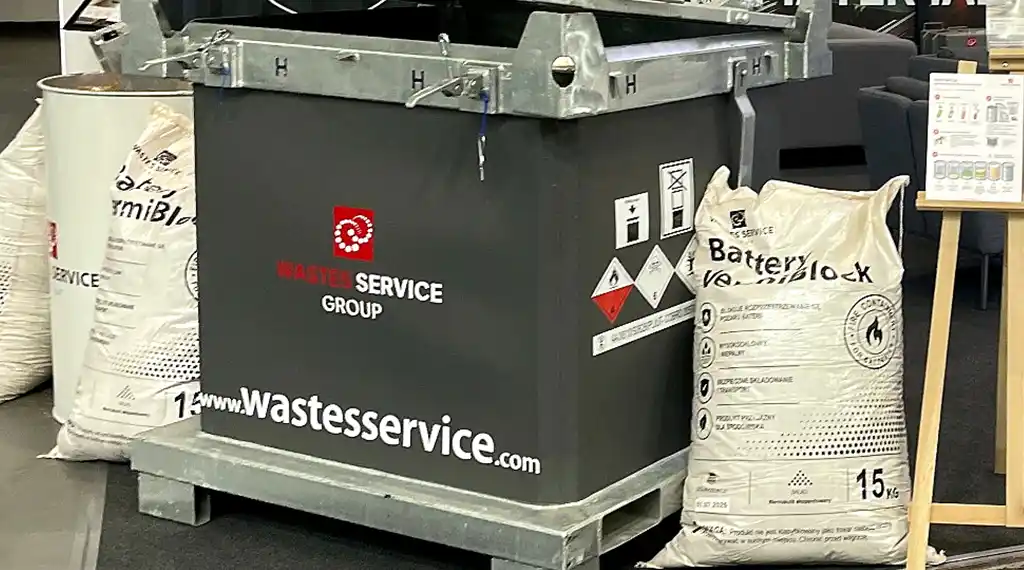
These materials must be transported in strict compliance with the ADR agreement (Accord européen relatif au transport international des marchandises Dangereuses par Route) of 1957, which governs the carriage of dangerous goods by road. You should only use certified ADR containers, in which batteries are carried in high-grade steel containers with pressure equalisation systems. A specialist storage and transport service ensures full compliance with short-circuit protection standards. Remember that for loads above 333 kg the driver must hold the appropriate qualifications and the vehicle must be properly marked. Commitment to ADR standards is not only a legal requirement but above all a sign of care for public health.
A correctly prepared consignment note, written instructions for the driver and up-to-date packaging certificates are the most important parts of your documentation. You must make sure transport units are precisely marked with UN numbers, which makes the work of emergency services easier in the event of a collision. Working with an experienced partner such as Wastes Service makes it possible to automate reporting and GPS monitoring. The documentation should also include the weight of the load and the exact chemical specification of the cells being transported. Complete paperwork protects a company from heavy administrative penalties and insurance complications.
The most serious failings include using uncertified containers and not regularly monitoring the physical condition of stored cells. Users often ignore visible mechanical damage or swollen casings, which is a direct road to disaster. You should always make sure that untrained people are not involved in storing and transporting batteries. Ignoring recommendations to keep different chemistries apart can lead to uncontrolled ignition inside collection containers.
Using ordinary cardboard boxes or plastic containers without absorbent fillers such as vermiculite poses a direct threat to the surroundings. Without proper protection, the risk of a battery fire rises dramatically, especially when exposed to the vibrations of road transport. Choose solutions offered by professional Li-ion battery recycling services that rely on certified metal boxes. Packaging without certification is a sign that the process does not meet safety standards and may be stopped by road transport inspectors.
Irregular sorting and the lack of systematic temperature measurement in the warehouse are the factors that most often lead to uncontrolled incidents. You should introduce clear instructions on what to do if an electrolyte leak or smoke from a container is detected. Neglecting staff training means the team's response in a crisis is often chaotic and ineffective. Only strict adherence to procedures allows Li-ion batteries to be stored predictably and without stress. It is your duty to ensure that every stage of the waste's journey is precisely described and supervised.
Modern systems based on artificial intelligence and thermal imaging cameras can detect heat anomalies long before a fire breaks out. Your logistics can be strengthened by RFID sensors and QR codes that allow every batch to be tracked in real time. Cloud analytics make it possible to anticipate potential threats and react before a problem escalates. X-ray systems for automatically sorting cells on conveyor belts are already appearing on the market. Technical solutions like these are taking the safety of high-voltage batteries to a completely new, digital level.
Effective risk reduction means making the route from where the waste is generated to its final treatment as simple as possible. You should aim to transport battery waste without unnecessary reloading or intermediate storage points. The less time the material spends on the road, the lower the likelihood of mechanical damage. Your business model should include regular contact with professional collection points, which ensures smooth operations. A stable logistics chain is the foundation on which you build the trust of your business partners and regulators.
Direct deliveries to modern recycling plants are the most effective way to reduce operational risk. In this context, a modern recycling plant in the CEE region makes it possible to hand over materials for processing quickly. By cutting out unnecessary stops, you reduce the cells' exposure to changing weather conditions and vibrations. These steps also help optimise the cost of the whole waste management process.
Wherever battery waste is stored, there must be an effective system for alerting emergency services and special extinguishing agents. Water is often ineffective for putting out lithium battery fires, which require specialist isolating agents. Your procedures should include immediately sealing off the danger zone and starting forced smoke ventilation. Regular evacuation drills and incident simulations help the team stay calm in a real emergency.
The company uses advanced steel containers and AI monitoring systems to ensure the highest protection standards at every stage of cooperation. Working with Wastes Service gives you access to a fleet that meets the strictest European standards. Thanks to QR and RFID technology, processes are fully transparent and ADR-compliant, and lithium-ion batteries are transported with the utmost care. You can also rely on the recovery of valuable metals such as lithium and cobalt in a safe, controlled environment.