
Not every retired traction battery is waste. Its condition, operating history and safety need to be checked first. Only testing will show whether a second life for the EV battery, repair, repurposing or recycling is possible. A battery pack should not be qualified solely on the basis of the car's age or mileage. What matters is the level of wear, how the battery was used and even the number of charging cycles completed so far.
Second life means using a battery after it has finished working in a car, usually in a less demanding stationary installation. It can involve the entire pack, selected modules or a change of its original function. Regulation (EU) 2023/1542 distinguishes between reuse, preparation for repurposing, repurposing and remanufacturing.
Did you know?
Growing car sales increase the future stream of used battery packs. Some will retain their usable value, while the remaining EV batteries will require safe processing. Wastes Service Group handles, among other things, the collection, identification, logistics and recycling of batteries.
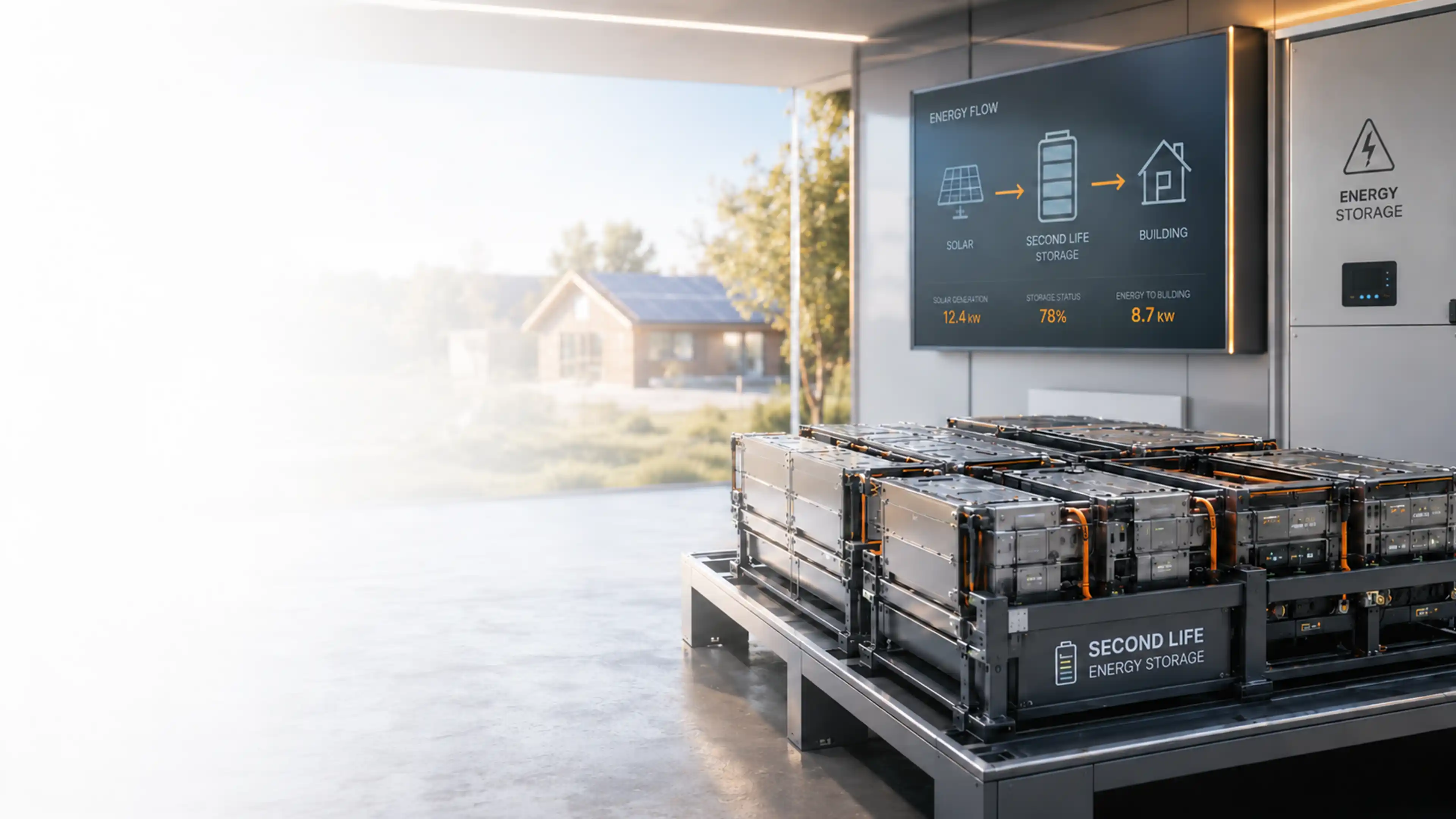
Cars often require high power, fast charging and a stable range. A stationary installation can operate more slowly and in more controlled conditions. For this reason, a traction battery that no longer meets the vehicle's requirements can still power a properly designed energy storage system.
There is no single EU SOH threshold that qualifies a battery for a second life. For passenger cars, Euro 7 requires 80% of energy for up to 5 years or 100,000 km, and 72% for up to 8 years or 160,000 km. These are durability parameters in the vehicle, not a threshold for stationary storage.
The assessment covers battery SOH, resistance, energy, power, self-discharge and differences between modules. The BMS, insulation and any signs of overheating, flooding or collision must also be checked. Before collection, battery transport and storage should be planned, ideally with a trusted partner.
Electric car batteries often retain part of their capacity after their time in the car ends. A stationary installation, however, does not require the same power, weight and resistance to changing conditions. In practice, used car batteries can be reused in at least 3 ways:
Each system requires matching voltage, BMS, cooling and protection. Second life batteries are not a random set of used modules. The design must account for durability, servicing and failure response. Rejected components should go to raw material recovery from batteries.
The most common destination is stationary energy storage. Energy storage systems built from EV batteries can operate at buildings, industrial plants, renewable energy farms, logistics centres and charging stations.
A complete pack can be used, or it can be dismantled down to module level. This kind of battery repurposing gives more control over parameters but increases the cost of testing and integration. For regular supplies, cooperation with Wastes Service Group can help.
Proper EV battery diagnostics combine data stored in the BMS with visual inspection and measurements taken outside the vehicle. A capacity reading alone does not confirm safety.
The following should be checked:
EU rules require a documented state of health assessment for a waste battery. Tests must confirm its ability to work in its new role. Battery reuse cannot rely on the seller's declaration.
Qualifying a battery for recycling begins when instability, serious damage or overheating is detected. The state of charge, hazard, waste code and required packaging must then be determined.
EV battery recycling is the right choice when further operation cannot be safely predicted. This also applies to packs without a history, where testing and adaptation would not be cost-effective.
Professional Li-ion battery recycling makes it possible to recover lithium, nickel, cobalt and copper. From the end of 2025, the EU recycling efficiency target for lithium-based batteries is 65% of their average weight. Regulation (EU) 2025/606 sets out the method for calculating and verifying this result.
Transporting lithium-ion batteries requires classification in line with ADR 2025. A working, used, damaged pack or one liable to react dangerously may require different packaging, labelling and documentation. Damaged batteries may fall under special provision 376. A pack involved in a collision must not be transported like a working component removed from a vehicle.
Safe EV battery storage requires separate zones, protection against water and short circuits, and temperature control. Pack traceability and a procedure for responding to rising temperatures are also needed. The experience of Wastes Service Group shows how important monitoring and specialised facilities are.
Second life and recycling serve consecutive stages of the material cycle. A circular economy for batteries means first preserving their safe usable value and then recovering the materials.
Further use without reliable testing can increase fire risk and servicing costs. Li-ion battery recycling, in turn, supports access to critical raw materials. By the end of 2027, the EU requires the recovery of at least 90% of cobalt, copper and nickel, and 50% of lithium.
A specialised operator chooses the path based on the condition of the pack, regulations and the economic case. It should not send every battery to the same process.
Such an operator can:
A sound decision combines technical, logistics and waste management expertise. Raw material recovery from batteries covers packs that cannot be safely and economically reused. A good model combines selection, further use and recycling.
Sources: