
As the number of electric cars grows worldwide, workshops, fleets and insurers increasingly deal with fire-damaged batteries and vehicles damaged in accidents. Around 21 million electric cars were sold in 2025, more than 20% up on the previous year. Every compromised battery pack first needs a risk assessment, followed by a decision on repair, transport, reuse or recycling. You cannot assume that all batteries involved in a crash are in the same technical condition.
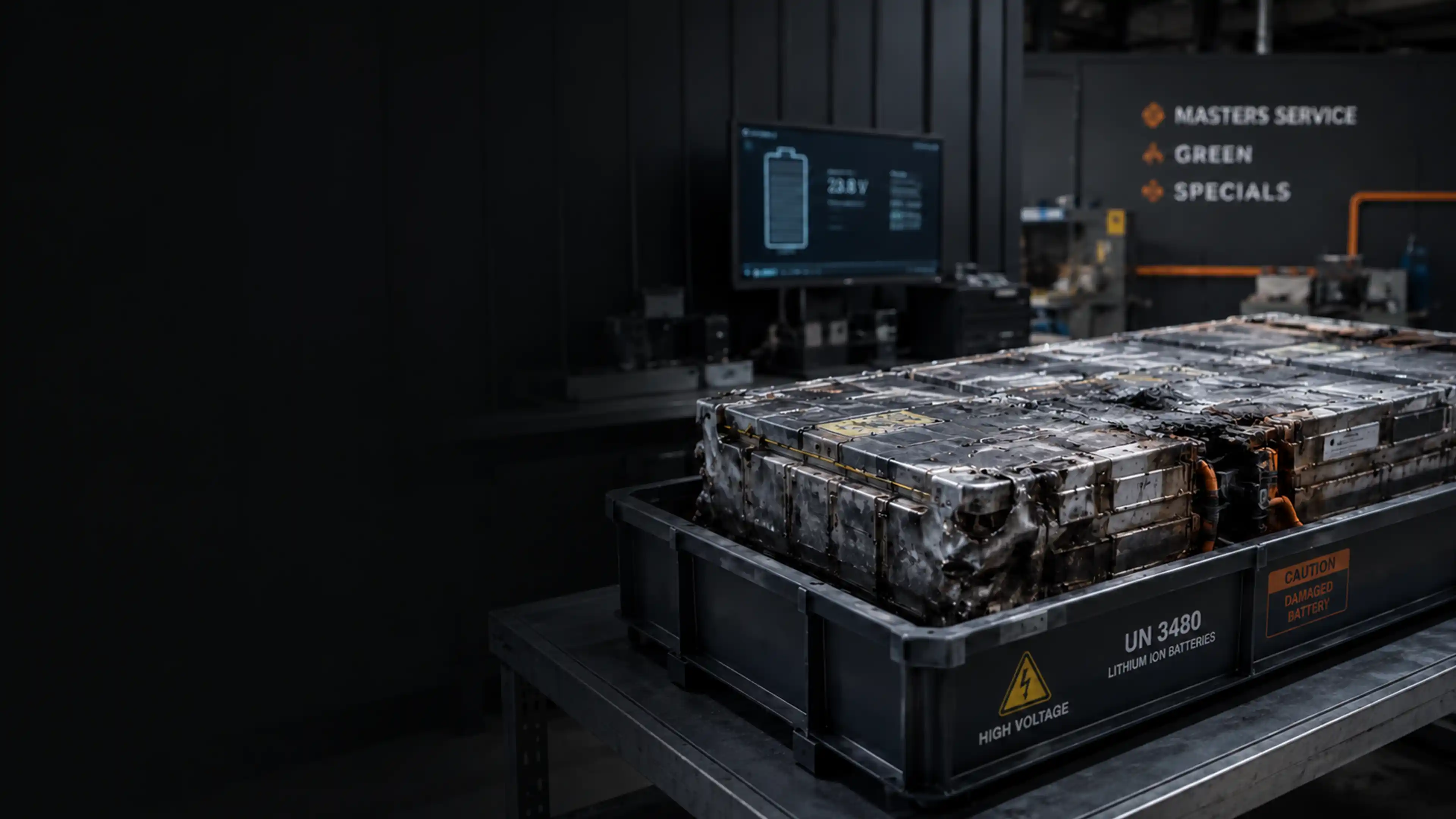
An EV battery may look intact after a crash, even though cells, wiring or the cooling system have been damaged inside. Energy remains in the pack even after the car is switched off. That is why a traction battery should never be moved after an accident without first being secured.
The main reasons:
In practice, damaged lithium-ion batteries can change condition as soon as the car has been towed. The first step is to identify the battery model, the type of incident and any visible symptoms. Next, temperature, casing, insulation and the possibility of safe disconnection are assessed. Only then can battery transport and storage be planned.
Fire, water and impact cause different types of damage. In every case, the pack needs an inspection and a procedure matched to its condition. An undamaged casing does not prove that the battery is safe.
Table 1: Potential consequences of damage to vehicle batteries after collisions, accidents and fires.
Batteries after a fire require particular caution, as they can heat up again after the emergency response has ended. The effects of flooding may also appear with a delay. If further use is not safe, lithium-ion battery recycling may be the right solution.
Thermal runaway is an uncontrolled rise in cell temperature. The chemical reactions generate more and more heat, which can lead to gas emissions, fire and the reaction spreading to neighbouring cells.
Take a module with one cell crushed in an accident. An internal short circuit causes heating, and the heat passes to adjacent components. In this way, the reaction can spread across the entire module. This is why the fire risk of Li-ion batteries does not always end once the first fire has been put out. Controlled processing later enables raw material recovery from batteries, including lithium, nickel, cobalt and copper.
The assessment should not be based on photos or on how the car looks. It should be carried out by people trained to work with the specific pack and high-voltage system. Responsibilities include:
Qualifying a battery for recycling should be based on the inspection results. The pack can also be sent for further testing. Documentation should describe the incident, symptoms, measurements and the decision taken. If you handle claims regularly, it is worth setting clear rules through a battery handling partnership, for example with Wastes Service.
No. Under EU law, waste is any substance or object which the holder discards, intends to discard or is required to discard. A crash alone does not determine the battery's status. After testing, a pack may be suitable for repair, reuse or for harvesting working modules. When further use is not possible, it becomes lithium-ion battery waste and must be handed over to an authorised operator.
For example, a minor rear-end impact does not necessarily affect the battery in the vehicle floor. On the other hand, a seemingly light underbody impact can damage the casing, cooling system or insulation. The decision should be based on diagnostic results, not on the condition of the bodywork.
Transporting damaged batteries requires prior classification and proper securing. A regular pallet, stretch film and a standard delivery van may not be enough.
ADR 2025 includes specific provisions for damaged or defective lithium batteries. The requirements depend, among other things, on whether the battery is liable to react dangerously or produce flames, heat or gas. The risk of short circuit, movement of the pack and further damage to the casing must be reduced. Packaging or containers are selected according to the battery's weight, dimensions and condition. Proper documents, labelling and a prepared carrier are also required.
The workshop should pass on information about the accident, flooding, temperature and visible damage. The carrier should not be the one establishing the condition of the pack at the moment of collection. In difficult cases, the experience of Wastes Service Group or another operator specialised in such jobs makes the difference.
EV battery storage should take place in a separate, controlled area. The pack is protected against short circuits, further impacts, rain and access by unauthorised persons. High-voltage batteries require monitoring of temperature and casing changes in proportion to the risk. There is no single quarantine period for all cases, so the observation time should follow a specialist's assessment and the manufacturer's recommendations.
Regulation (EU) 2023/1542 sets a minimum recycling efficiency of 65% by average weight for lithium-based batteries by the end of 2025. From 2030, the target rises to 70%.
EV battery recycling should combine safety checks with documented processing.
In 2025, 4.2 million electric cars were sold in Europe, more than 30% up on the previous year. A growing number of vehicles means more claims that require diagnostics, logistics and insurance decisions to work together.
A good procedure divides tasks between roadside assistance, the workshop, the insurer, the carrier and the recycler. It also specifies the documents and the person who approves next steps.
The partner should handle identification, securing, collection, storage and further management. It must distinguish between NMC, NCA and LFP chemistries, as each requires a different approach during dismantling and processing. Battery traceability and flow documentation also matter.
Wastes Service Group provides its own transport in Poland and the EU, as well as 24/7 monitored containers for batteries. The company identifies cell chemistry, condition and design, then carries out testing, discharging and dismantling of BEV, HEV and PHEV packs.
Assess the battery first, then plan logistics and further use. Not every pack involved in an incident has to be recycled, but every one needs a documented decision. Such a process reduces risk and enables raw material recovery from batteries while meeting safety requirements.
Sources: