Lithium-ion batteries are now the main power source for cordless devices, workshop tools and electric vehicles. Their high energy density, however, means an increased risk of a violent fire with a specific chemical course. Standard extinguishing agents do not always stop thermal runaway in the cells, because the reactions inside the battery can continue even after the flames have been suppressed. This overview explains how thermal runaway develops and presents technical ways of bringing the fire under control with cooling and mineral barriers. Learn proven rules of conduct that will help you protect your workplace against the dangerous effects of a chemical ignition.
The biggest problems during battery ignition are caused by violent thermal runaway. It is triggered by an internal short circuit, a manufacturing defect, mechanical damage or overcharging the pack at too high a voltage. During this reaction, the temperature in the core of the cell can in extreme cases reach very high values, locally even exceeding 1000°C. The overheated battery releases flammable gases and toxic chemical compounds, including hydrogen fluoride, carbon monoxide, hydrogen and hydrocarbons. A cloud of escaping gases in an enclosed space creates a direct risk of explosion, and the released energy can spread to neighbouring cells in the module. Even after the open flame has been put out, you must expect re-ignition, which can occur several hours or even up to a day later.
An ordinary powder extinguisher can suppress the visible flame outside the casing without affecting the reaction taking place deep inside the pack. A stream of carbon dioxide does not bring a lasting result either, because the gas escapes quickly and does not remove the accumulated heat from inside the cell. During professional rescue operations, firefighters use water in a way adapted to the situation, treating it as an agent that intensively cools the structure.
With large packs, this may require significant amounts of water and raises the problem of safely managing contaminated firefighting run-off. Putting out the flame alone does not stop the self-sustaining chemical degradation, which is why, in addition to cooling, solutions that limit heat transfer to the surroundings are used.
Expanded vermiculite, a natural layered aluminosilicate mineral, is used for preventive and protective purposes. It is produced by rapidly heating the ore in industrial furnaces, which causes the water trapped in its crystal structure to evaporate violently. The mineral grains then expand more than ten times, turning into light, completely non-combustible flakes with an accordion-like structure. The material remains stable under extreme conditions and withstands temperatures from -200 to over 1100°C. A layer of the material envelops the heated element, limits heat transfer and can absorb electrolyte leaking from ruptured cells.
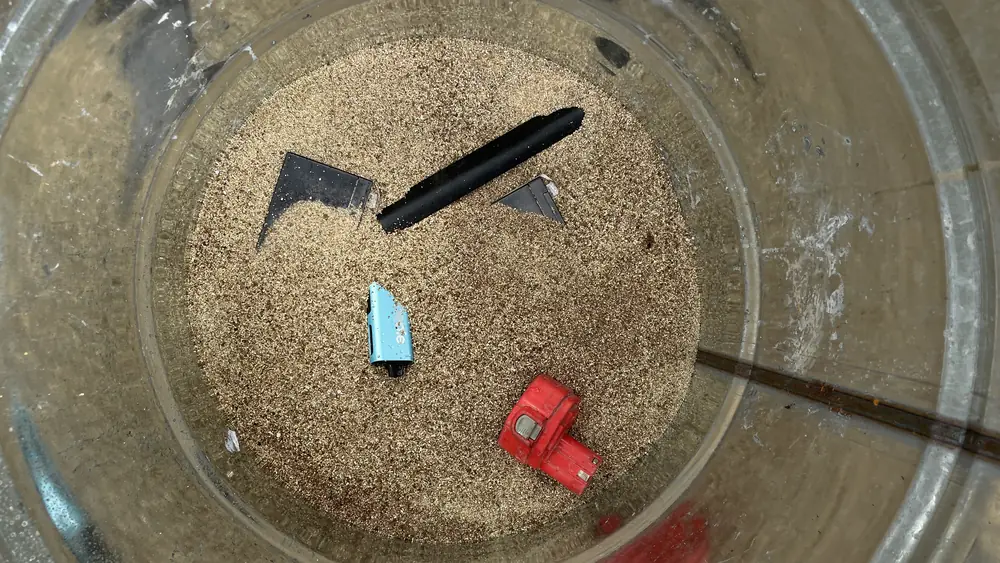
On the technical safety market you will find two different forms of this mineral, each with a different operational function. Dry vermiculite in the form of loose granules is used to passively fill the spaces between cells and to line storage boxes. It limits heat transfer to adjacent components and cushions mechanical shocks when batteries are moved.
Aqueous vermiculite dispersion, abbreviated AVD, is a liquid extinguishing agent containing microscopic mineral particles suspended in water in proportions that depend on the specific product. The water in the agent cools accessible surfaces, while the mineral layer that settles can limit oxygen access to burning materials. This does not guarantee that thermal runaway inside the cell will be stopped. Do not treat the two solutions as interchangeable: the granules are a passive thermal barrier, while the dispersion is an agent intended for suppressing specific fires in accordance with the manufacturer's instructions.
Proper organisation of a workshop or warehouse helps to limit the consequences of a possible ignition of battery packs. The basic task of technical staff is to keep a physical distance between stored high-voltage modules. Batteries should be placed in suitably selected containers, adapted to their condition and the hazards associated with them. Where justified, the free space between the container walls and the batteries can be filled with a mineral that limits heat transfer. If you notice that a battery has been mechanically crushed or has swollen, take it out of service immediately and place it in a designated insulated bay.
Introducing these guidelines into the daily warehouse routine reduces the risk of a local failure developing into an uncontrolled fire of the entire building. Regularly inspect high-current connectors, which can generate an electric arc during charging and ignite the casing. Technical staff should complete practical training in recognising the symptoms of a failure and implementing procedures for handling damaged modules. In battery charging zones, it is worth installing gas detectors and automatic early temperature-rise detection systems. Also remember to keep a stable ambient temperature in the warehouse, avoiding direct sunlight and excessive humidity.
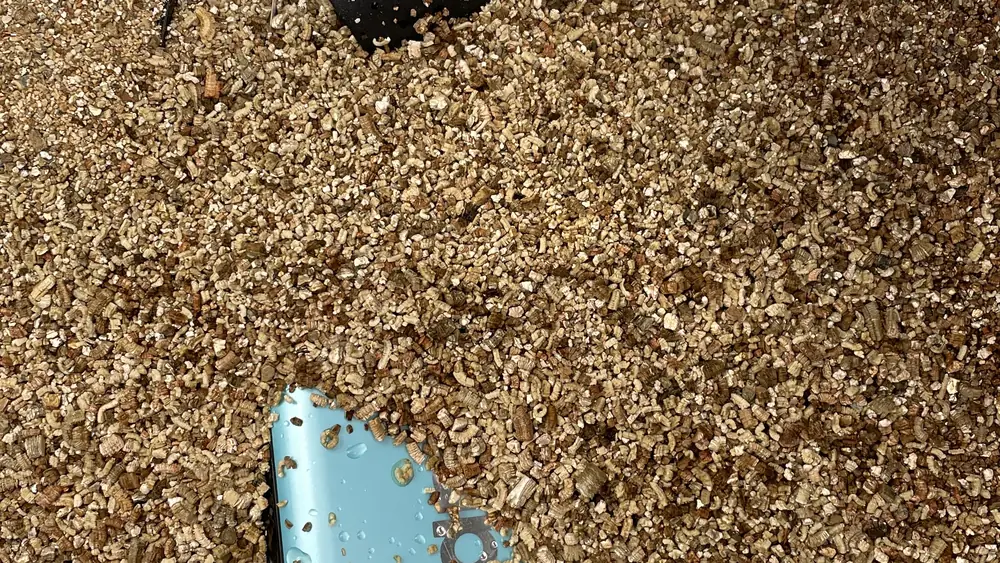
Mineral materials such as expanded vermiculite are widely used in e-waste recycling plants, where thousands of used cells are dismantled. You will also find these solutions in authorised electric vehicle service centres, where traction packs from road collisions require safe quarantine and stable isolation.
In large-scale energy storage facilities built with BESS technology, properly designed mineral barriers can limit heat transfer between installation components. The material can be used as a filling for suitable battery transport packaging, provided that it meets the relevant ADR requirements. Mineral filling is also used by municipal waste collection points, where residents leave used power tools and lithium batteries, which are then sent for lithium-ion battery recycling.
Signs of a failure may include the characteristic whistle of escaping gases, a swelling casing and an unusual smell; however, you should not approach the battery to identify it. As soon as white or grey clouds of smoke appear, disconnect the mains power immediately if you can do so without approaching the pack. Do not try to extinguish such a cell with an ordinary household extinguisher, as the powder stream will not penetrate a sealed module. Evacuate everyone from the room, close the fire doors behind you and call the fire brigade without delay. After the rescuers have suppressed the visible flame, the battery requires safe isolation and monitoring because of the risk of re-ignition. The observation period is determined on the basis of a risk assessment.
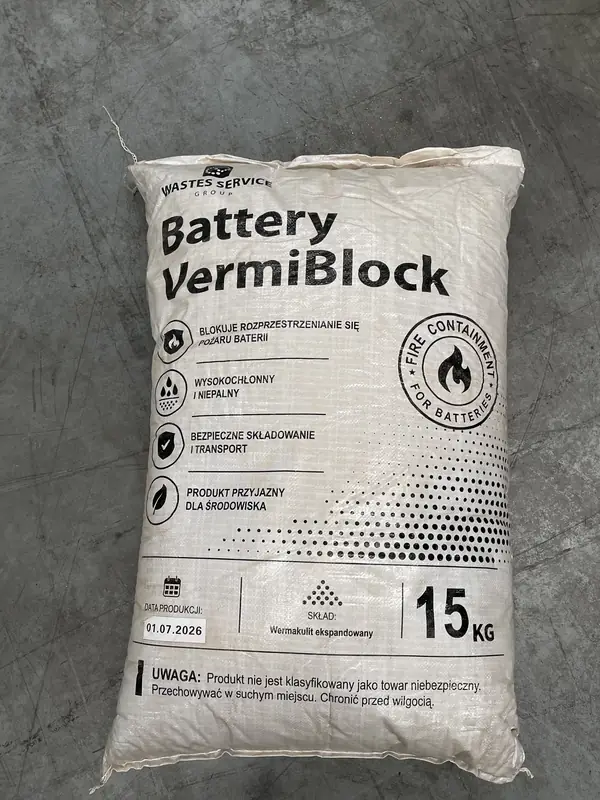
For demanding industrial facilities, Wastes Service Group offers Battery VermiBlock, a vermiculite-based solution. The material can act as an insulating barrier that limits heat transfer between battery components. Thanks to its liquid absorption capacity, the material can soak up electrolyte leaks, although it does not replace neutralisation or appropriate safety procedures. You will find detailed technical parameters and packaging options on the Battery VermiBlock - vermiculite battery insulation page in our protective solutions catalogue. If you are planning to protect an energy storage facility, a vehicle dismantling station or a transport fleet, contact our advisers via the contact form to have a material calculation prepared.