
In 2024, 216,000 passenger cars were produced in Poland. That's nearly 28 percent lower than a year earlier. At first glance, this is just another statistic. In reality, however, it shows the change in pace, scale and direction of the entire automotive sector.
The decline in production is not a single event. This is the result of overlapping factors: regulatory pressures, changes in demand, technological transformation and investment uncertainty in Europe. The Polish automotive industry, which is strongly linked to global supply chains, is feeling the effects of these processes particularly clearly today.
Limiting the number of vehicles produced does not mean that there are fewer challenges. Their character changes. Automotive is moving more and more towards electromobility, and with it the importance of batteries as a key component of a vehicle is growing.
The battery ceases to be an exclusively technical element. It becomes a resource that must be managed over a long time horizon — from the moment it is placed on the market, through exploitation, to the development and recycling stage.
Every production decision made today affects this:
Automotive transformation is not just a change of drive. These are also new responsibilities in the area of safety, recycling and protection of raw materials. As the number of electric vehicles increases, the importance of an efficient waste battery management system increases.
From the perspective of the waste and raw materials market, car production figures are an early signal of upcoming changes. Less production today could mean a time shift in the flow of spent components tomorrow. At the same time, the material structure of vehicles is changing, which requires adaptation of processing technology and business models.
At Wastes Service Group, we look at such indicators as a piece of a larger puzzle. Analysis of production trends allows you to better prepare for future waste volumes, plan processing capacities and adapt safety systems to new types of components, including lithium-ion batteries.
The automotive transformation is a process that is happening in parallel in the areas of industry, regulation and resource management. The decline in car production in 2024 is not just a statistic. This is a signal that the sector is entering the next phase of change — and with it, the responsibility for the resources that go to market is changing.
24/9/26
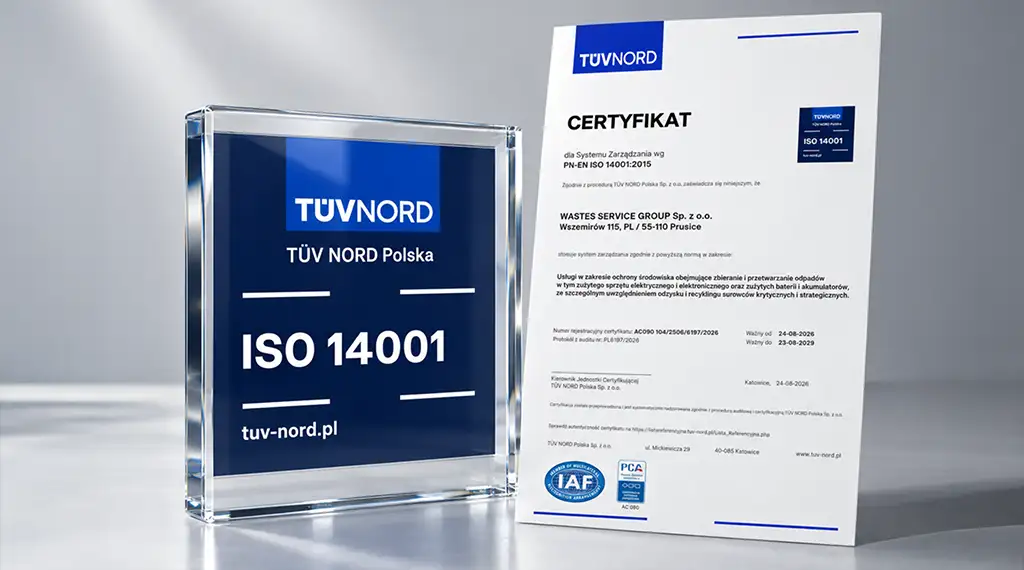
Wastes Service Group has officially achieved the PN-EN ISO 14001:2015 certification awarded by TÜV NORD Polska.