

From a recycling perspective, the situation looks much more demanding. With the increase in the share of LFP batteries, the problem of their profitable processing increases.
The main reason is the chemical composition of these batteries. Unlike technologies such as NMC, LFP cells do not contain valuable metals such as cobalt or nickel.
It is these raw materials that have largely been responsible for the cost-effectiveness of battery recycling in existing business models. Their absence means lower potential for value recovery and much smaller margins for processing companies.
In practice, this means that recycling LFP batteries in Europe will very often generate losses.
Nickel-rich batteries, such as NMC, still allow you to generate profits thanks to the value of the recovered raw materials. This means that the business models of recyclers so far have been based precisely on this technology.
The growing share of the LFP, however, is changing the rules of the game. Businesses can no longer rely solely on the sale of recovered materials as their main source of revenue.
This is the moment when it is necessary to redefine the whole approach to battery recycling.
Against the background of Europe, the advantage of Asian players, above all China, can be clearly seen. Material recovery facilities are, on average, up to five times larger than in the United States.
The scale of the business, lower labor costs and access to a huge raw material base allow Chinese companies to achieve profitability even with low lithium prices.
In 2023, in China alone, LFP cells accounted for about two-thirds of the capacity of electric vehicle batteries sold. This further strengthens their market position and technological expertise.
Europe is facing a strategic challenge today. Without changes in the approach to recycling LFP batteries, there could be a situation in which the continent will become dependent on Asian processing capacity.
This is not only a matter of business, but also of raw material security and technological independence.
In order for European recyclers to function effectively in the new realities, concrete changes are needed at both business and regulatory levels.
The first direction is the development of a service model in which companies provide battery processing for a fixed fee. Such a model reduces the risks associated with fluctuations in raw material prices and ensures financial stability even with a low value of recovered materials.
The second key element is regulation. With a low value of the LFP battery, market mechanisms are not enough. Strict requirements under extended producer responsibility and bans on battery storage are essential.
The example of lead-acid batteries shows that properly designed regulations can create a leak-proof and cost-effective recycling system.
In Poland, it is necessary to create a coherent system for collecting and financing the recycling of LFP batteries. Reliable reporting of all batteries placed on the market and reducing the grey area is crucial.
Full responsibility of manufacturers for the entire life cycle of the product is the foundation of an effective system.
The development of recovery infrastructure should be seen as a strategic investment and not just an operating cost.
The growing popularity of LFP batteries is changing the economics of the entire recycling industry. This is the moment when Europe must take decisive action to maintain competitiveness and independence.
Without regulatory support and new business models, the European market may not meet Asia's growing advantage.
24/9/26
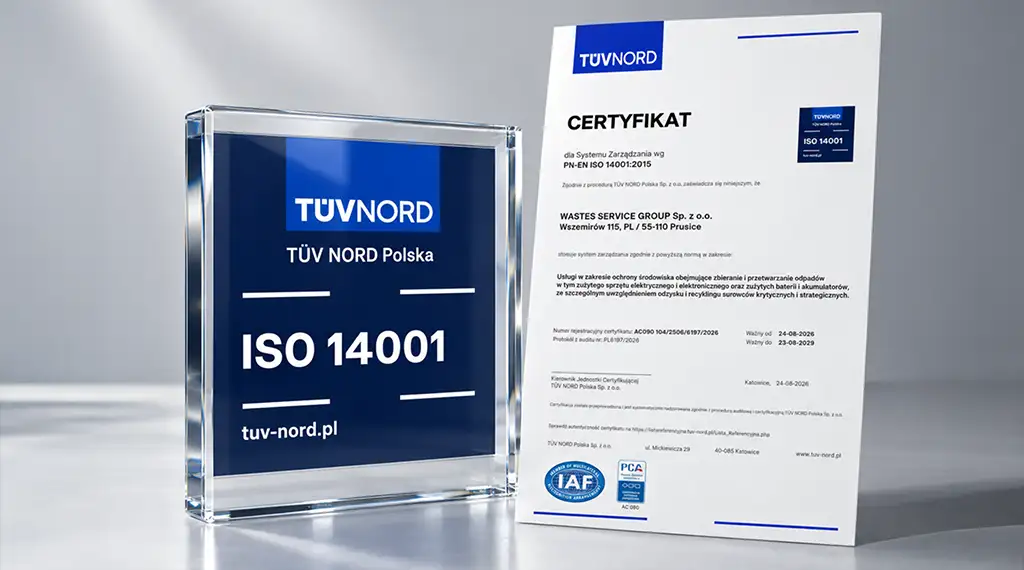
Wastes Service Group has officially achieved the PN-EN ISO 14001:2015 certification awarded by TÜV NORD Polska.