

The current model based on the assembly of internal combustion and hybrid cars for Japanese manufacturers ceases to be competitive.
The reason is a simple ruthless economy and a dynamic change in the global balance of forces in the automotive industry.
While global car sales are growing at a moderate rate of about 2 percent a year, China is clearly ahead of the rest of the world. In 2024, they reached a production level of more than 31 million vehicles, accounting for about 30 percent of the global market.
Even more impressive is their export expansion. Since 2019, Chinese car exports to the European Union have increased by about 1,600 percent.
It is no longer just development, it is dominance that is redefining the global market.
Against this background, Thailand, with a projected production of about 1.4 million cars in 2025, is beginning to lose relevance.
The country is facing several challenges at the same time. Domestic demand is falling, mainly due to high household indebtedness. At the same time, export markets, which until now formed the basis for the development of the industry, are shrinking.
Additional pressure is exerted by political decisions and increasing regional competition. The United States has imposed tariffs of 19 percent on cars from Thailand, which hits pickup exports. Vietnam and Indonesia are building a stronger position in the region, attracting investors with lower labor costs.
Thailand is increasingly becoming a manufacturing base for Chinese electric car manufacturers. Today, brands from China control 80 to 89 percent of the EV market in the country.
However, this is not equivalent to the development of local industry. Thailand does not have its own strong brands or R&D facilities that would allow it to compete technologically.
In the context of forecasts that autonomous driving could become the standard by 2030, the lack of investment in R&D is becoming one of the biggest threats.
From the perspective of the industrial market, we are seeing a deep, structural restructuring of supply chains. The displacement of traditional assembly lines by electromobility technologies means the physical transformation of factories.
This is not only a change in production technology, but also the need to manage the decommissioned infrastructure and prepare to handle the growing number of lithium-ion batteries.
This process requires a comprehensive approach involving safe disposal, recycling and the construction of new material cycles.
Despite the challenges, Thailand still has a chance to maintain its position, provided it adapts quickly.
It will be crucial to enter the supply chains related to electromobility and batteries and attract investment in research and development.
Without this, the country can remain only a place of assembly without a real impact on the development of technology and added value.
The changes taking place in Thailand are part of a broader global trend. The automotive industry is undergoing one of the biggest transformations in its history.
The growing dominance of China, the development of electromobility and new technologies such as autonomous driving are changing the rules of the game for all market participants.
Thailand today faces the choice of further development or marginalization in the global value chain. Without investment in new technologies and competences, the country may lose its previous position.
At the same time, the transformation of the automotive market opens up new opportunities for those who are ready to act quickly and strategically.
24/9/26
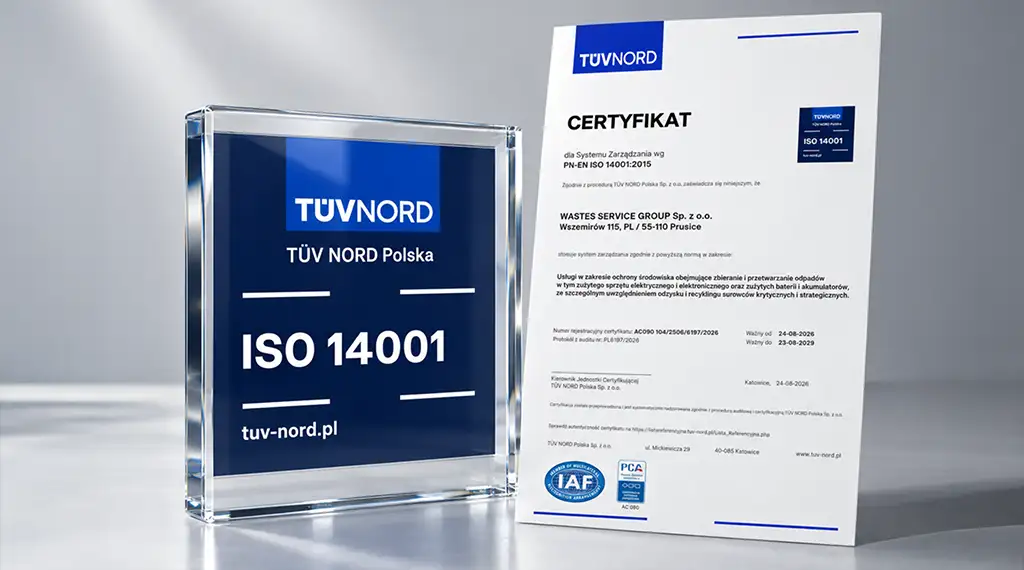
Wastes Service Group has officially achieved the PN-EN ISO 14001:2015 certification awarded by TÜV NORD Polska.