

The current result of 27.6 percent places us only in 22nd place among the countries of the European Union.
It is not only statistics that are a real signal that the waste management system in Poland needs to be accelerated and changed.
To understand the scale of the challenge well, it is worth looking at the broader context. The average level of recycling in the European Union is now 47.7 percent, which means that Poland significantly deviates from the European standard.
The leaders of the list, such as Germany, reach a level of as much as 68.7 percent. So the difference is not only noticeable, but even systemic.
This shows that it is not just a question of individual actions, but of a comprehensive approach to the entire waste management system.
The European Union is consistently developing a circular economy model in which waste is minimised and raw materials remain in use for as long as possible.
Currently, the circularity rate in Europe is less than 12 percent. The goal is to double it by 2030.
This means huge changes for industry, manufacturers and the entire supply chain. Recycling is no longer an additive and is becoming one of the foundations of the modern economy.
In order to achieve the objectives set, the European Union is implementing a series of concrete solutions that aim to change the way products are designed, used and processed.
Key directions are the development of the right to repair, which extends the life of products and reduces the amount of waste. Ecodesign requirements, which take into account future recycling already at the production stage, are also becoming increasingly important.
In 2026, the Circular Economy Act is planned to be adopted, which will further promote the use of secondary raw materials and increase the pressure for market transformation.
Poland today faces a big challenge, but at the same time a huge opportunity. The low level of recycling means the need for systemic change, investment and education.
This is the moment when both companies and consumers should change their approach to waste and raw materials.
Better segregation, infrastructure development and the deployment of modern technologies can significantly improve the situation and bring us closer to European standards.
The data leave no illusions Poland needs to accelerate the transition towards a circular economy. The gap between us and the leaders of the European Union is big, but it can be made up for.
Actions at many levels, from regulation to business to daily habits, will be key.
It is they who will decide whether the objectives set for the coming years will be achieved.
24/9/26
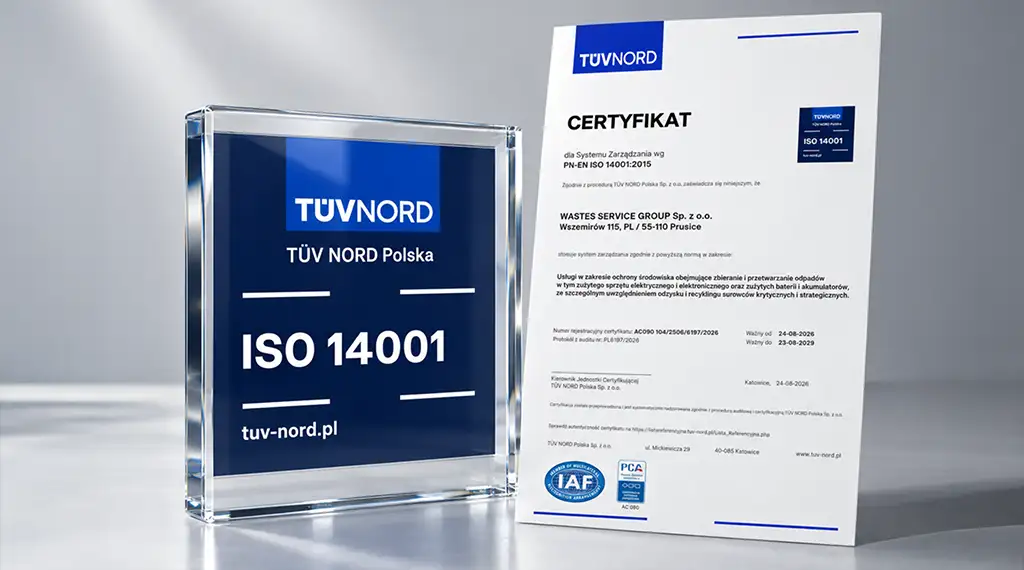
Wastes Service Group has officially achieved the PN-EN ISO 14001:2015 certification awarded by TÜV NORD Polska.