
The UK figures show how fast the problem is growing, and the EU Battery Regulation sets out how the industry is expected to respond.
Inside every lithium-ion cell, a thin separator keeps the electrodes apart. When a battery is crushed in a refuse truck compactor or damaged on a sorting line, that separator fails. The result is an internal short circuit and thermal runaway: a rapid, self-sustaining rise in temperature that can reach several hundred degrees Celsius and ignite paper, plastics and other combustible waste within seconds.
The risk is rising because small electronics with built-in batteries are cheaper and more widespread than ever, and many of them, disposable vapes above all, are designed to be thrown away.
The UK has some of the best-documented data on battery fires in the waste sector:
According to the ESA, lithium-ion batteries now account for almost half of all fires in the UK waste sector, while only around a quarter of UK councils offer any kerbside collection for batteries or small electricals.
The mechanism is the same in every market. Wherever spent batteries end up in mixed waste, fires in collection vehicles, sorting plants and waste storage follow. In Poland and across the EU, each incident means downtime, risk to staff, damaged equipment and rising insurance premiums for operators.
The solution starts upstream: spent batteries, disposable vapes and small electronics must be kept out of mixed waste and returned through dedicated collection points in retail stores and municipal waste collection centres.
Regulation (EU) 2023/1542 on batteries and waste batteries introduces measures that directly address this risk:
For producers, importers and distributors, this means building collection systems that are both effective and safe. For the rest of the chain, it means proper storage and transport of spent cells from the moment they are collected.
Most battery fires in waste management can be prevented before a cell ever reaches a refuse truck. Three elements make the difference:
Wastes Service Group specialises in the collection, transport and recycling of spent batteries and accumulators. We help businesses meet their regulatory obligations and manage battery waste safely. Contact us to find the right solution for your company.
Can a lithium-ion battery catch fire in a bin?
Yes. Ignition most often happens when waste is compacted in a refuse truck or on a sorting line and the damaged cell short-circuits internally.
How should disposable vapes be disposed of?
Disposable vapes contain a lithium-ion battery. They should be returned to a battery or electronics collection point in a store or at a municipal waste collection centre, never placed in general waste.
What collection targets does the EU Battery Regulation set?
For portable batteries: 63% by the end of 2027 and 73% by the end of 2030.
24/9/26
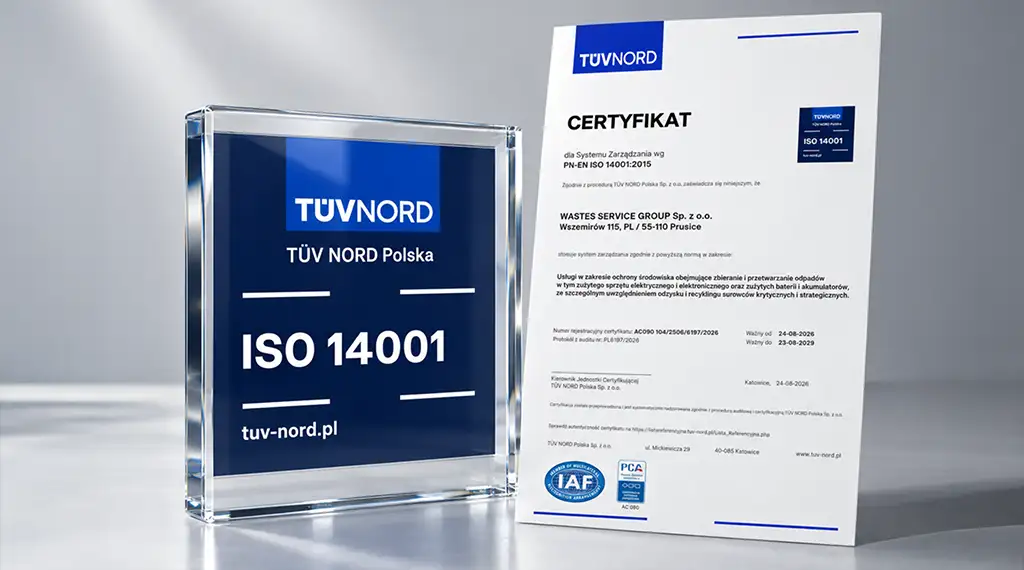
Wastes Service Group has officially achieved the PN-EN ISO 14001:2015 certification awarded by TÜV NORD Polska.